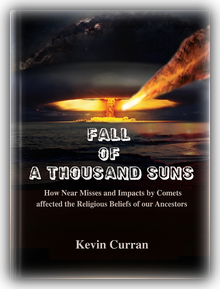
You can buy the book, Fall of a Thousand Suns: How Near Misses and Comet Impacts affected the Religious Beliefs of our Ancestors. It is available through iBooks and Amazon.
This website only lists information on modern-day comets and meteor showers. The book, however, thoroughly investigates how specific ancient impacts and near misses changed religious beliefs around the world.
Holsinger Meteorite

Holsinger Meteorite
50,000 BCE - Canyon Diablo (Arizona)
Two meteorites weighing a total of 4,814 pounds (2,183 kg) were found in 1922 near a Navajo reservation in Arizona. Navajo believed the meteorites were sacred.
Elsewhere in Arizona, Native Americans living in Camp Verde stored an iron meteorite in a feather blanket, carefully
buried in a stone cist. Ceramics near the meteorite dated between 1050 and 1150 CE.
Almost a hundred miles to the north of Camp Verde, the Sinagua tribe buried a 53-pound (23.5 kg) meteorite in a sixty-room pueblo they occupied from 1070 to 1275 CE. The meteorite was wrapped and carefully buried in the floor, reminiscent of how the Sinagua honored their deceased children.
REWRITE: Arizona would be short one giant hole in the ground if it wasn't for a 160-foot meteorite landing in the northern desert about 50,000 years ago, which left an impact crater about a mile wide and 570 feet deep. Known today as the Barringer Crater, or Meteor Crater, the site is now a popular tourist attraction. Scientists believe the meteorite that caused the crater was traveling about 28,600 miles per hour when it struck Earth, causing an explosion about 150 times more powerful than the Hiroshima atomic bomb. The meteorite itself probably melted in the explosion, spreading a mist of molten nickel and iron across the surrounding landscape.
REWRITE: The biggest fragment ever found is the Holsinger Meteorite, weighing 639 kilograms (1,409 lb), now on display in the Meteor Crater Visitor Center on the rim of the crater. Other famous fragments:

- 485 kilograms (1,069 lb), Canterbury Museum, Christchurch, New Zealand. The largest fragment outside the United States.[5]
- 360 kilograms (790 lb), Muséum national d'Histoire naturelle (MNHN), Paris
- 242.6 kilograms (535 lb), Verkamp's Store, Arizona[6]
- 225.9 kilograms (498 lb), Academy of Natural Sciences of Drexel University, Philadelphia, Pennsylvania.
- 194 kilograms (427 lb), Beloit College, Beloit, Wisconsin.
- 162 kilograms (357 lb), Meteorite Museum, University of California, Los Angeles [7]
- 136 kilograms (300 lb), Franklin Institute, Philadelphia.[8]
- 122 kilograms (269 lb), Griffith Observatory, Los Angeles, California. Fragment loaned by the Geology Department of Pomona College.
- 179 kilograms (395 lb), Griffith Observatory, Los Angeles, California.
- 100 kilograms (220 lb), California Academy of Sciences, San Francisco.
- 54 kilograms (119 lb), Newark Museum, Newark, New Jersey.
- Basket Meteorite (22 kilograms (49 lb)), Meteor Crater Museum, Arizona.[9][10]


REWRITE- Cool story about a stolen meteorite http://www.jsonline.com/news/milwaukee/41069052.html
- What is a meteor shower?
- What is a meteor storm?
- What is the radiant of a meteor shower?
- The first recorded meteor shower
- Giovanni Schiaparelli connects a meteor storm to a comet
xxx
xxx
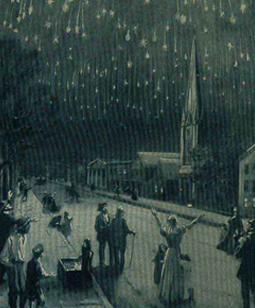
Newspaper depiction of the Leonid Meteor Storm of 1833
xxx
xxx
What is the Radiant of a Meteor Shower?
Imagine standing in a snowstorm at night. You would perceive all the snow falling at roughly the same speed toward Earth.
Now imagine getting in your car, at night, and accelerating to 50 miles an hour with the headlight on. What does that same snow look like in your car headlights? If you have ever lived in a part of the world where it snows, you don't have to imagine it. You know that the snow appears to radiate from a central point illuminated by your headlights. Why? It's due to your car moving quickly, at 50 miles an hour, through something that's moving much slower. Your perception changes.
Meteor showers work the same way. Earth is revolving around the Sun with immense speed. When it plows through the dust and debris left by a meteor shower, the meteors appear to radiate from a single point. Meteor showers are typically named after the constellation from which the meteors appear to radiate. For example, the meteors in the Orionid Meteor Shower appear to move away from the constellation Orion.

xxx
Credit: xxx
xxx
xxx
Related Links
- Comets
- List of Non-Periodic Comets
- List of Periodic Comets
- Biggest Meteor Storms in History
- Famous Meteorites
- Meteor Showers recorded by Ancient Korean Astronomers
- Meteor Showers recorded by Ancient Chinese Astronomers
- Meteor Showers recorded by Ancient Japanese Astronomers
- Parts of a Comet
- How does a comet get its name?
- Comets in 2026
- Comets in 2027
- Meteor Showers in 2027